Building a new business inside a company that had never done it
The CFO of the world’s best-known phone case company needed a second revenue line and diversification from flattening phone case market. He picked cloud gaming. I built the division, the team, and seven hardware products in eleven months, won a CES Innovation Award, and got us on shelf at GameStop and into the Xbox Cloud Gaming launch.
One revenue line, and competitors closing in on it
OtterBox is the phone case king: extreme durability, lifetime warranties, shelf space in essentially every retailer on earth. It is also, structurally, a single-vertical business. As the case market crowded with competitors, that concentration became the problem the board could see coming.
The CFO owned the diversification mandate and had already chosen the target: cloud gaming, then just starting to look like the Netflix moment for games. He hired me to build the product organization, find product-market fit in a category the company had never touched, and land platform partnerships with Xbox and Sony. Twelve months to design, manufacture, and launch.
We did it in eleven, the way the product community teaches it: seven products, a CES Innovation Award, an endcap test at GameStop, and a paid launch partnership with Xbox. Sony never happened, but thank God that Xbox did. The full lineup lives in the portfolio, alongside other case studies.
Let the gamers self-select
The company knew protection engineering and retail. It did not know gaming, which is why I was there. I have been building games since the Palm Pilot, then Game Boy Advance and Nintendo DS, then iOS and Android. That background is also why I put gamification into nearly every digital product I build: it is the cheapest loyalty mechanic there is.
Staffing was three direct reports plus shared resources drawn from a pool of twenty-seven industrial designers, all of whom already had day jobs on the core case line. I had carte blanche to recruit internally, so rather than assign people, I described the new division and invited concepts.
Some of them came back Monday with designs they had worked on over the weekend, unpaid, unasked. Those were the gamers, and those were the people I took. Nobody had to be convinced to prioritize a division nobody had heard of, because the ones who showed up had already chosen it.
Industrial designers pitched the new division, all with existing workloads
Unprompted concept work that told me exactly who wanted in
Direct reports and shared resources, every one of them a gamer
Three days in a room with people who actually play
We ran a three-day in-person focus group in downtown Denver with avid gamers. Not a survey, not a panel report. Three days of asking how they would play on a bus or a train, what accessories a streamed-games future actually requires, and what currently ruins a session.
One answer came back from everyone, unprompted and with real heat: the battery swap. You are deep in a high-intensity match, the controller dies, you are disconnected while the other players keep playing and gaining ground. Then you hunt for batteries, pop the old ones out, put new ones in, and reconnect. Nobody had solved it because nobody had asked.
A battery swap that never drops the connection
A rechargeable pack with a button cell inside, holding just enough trickle charge to keep the controller connected while the main battery is out. An LED throws light from the base to warn you roughly five minutes before you need to swap, and the kit ships with two batteries so you are never out of rotation.
One-handed removal and replacement. Back in the match in about fifteen seconds, still connected the whole time. This is the product that won CES.
Seven products, each one leaning on something OtterBox already knew
The portfolio logic was deliberate. Every product either used the company’s protection engineering or its retail relationships, and preferably both, so a brand-new division was not also a brand-new set of capabilities.
The battery kit was the innovation story. The mobile controller clip was the one that actually sold at GameStop. Those are rarely the same product, and a portfolio has to carry both.
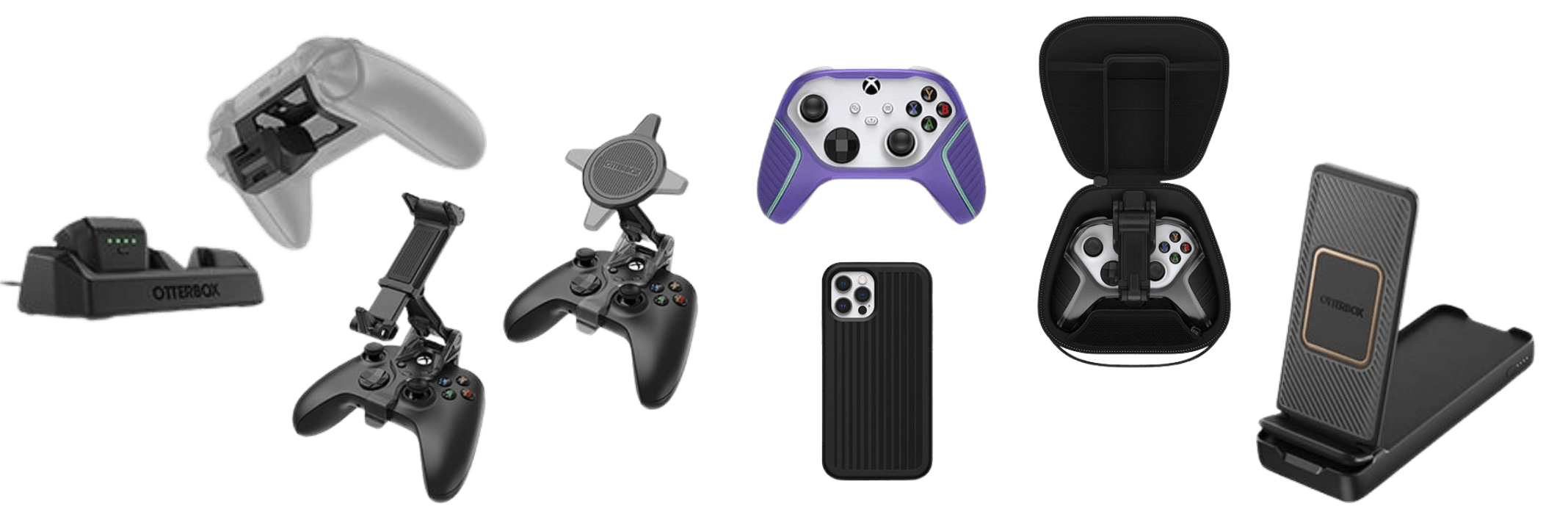
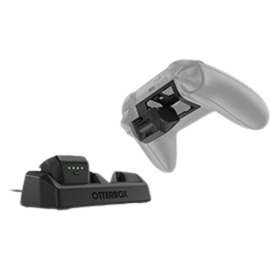
No Loss Connection Battery Kit
Rechargeable pack and stand with a trickle-charge button cell. Nothing else on the market does this.

Mobile controller clip
Clips onto an Xbox controller and holds your phone in the middle, so the controller becomes your cloud gaming rig.

Gaming phone case
A cooling pad between phone and case absorbs the heat streaming builds up over a long session.
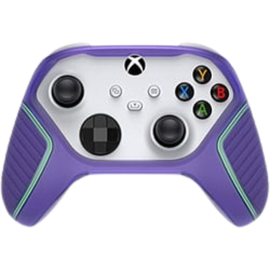
Controller shells
Protection engineering, the thing OtterBox is best at, applied to the controller instead of the phone.
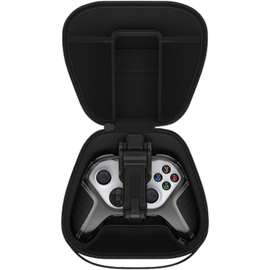
Xbox carrying case
Holds the controller and the clip together, because cloud gaming happens away from the couch.
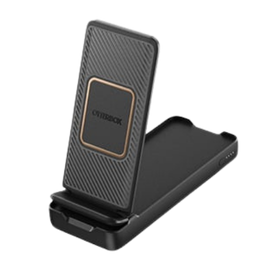
Phone charging stand
Folds flat, props the phone up, and keeps it powered. Streaming drains a battery fast.
Custom colorways for the Xbox Cloud Gaming launch
Xbox paid us to design custom-colored controller shells for their Cloud Gaming launch, which made us a launch partner rather than an accessory vendor. Revenue and validation in the same signature, and the clearest signal we had that a division under a year old was being taken seriously by the platform itself.
There is no patch after launch
CAD models correct to the millimeter. Tooling and molds that cost real money to cut and more to recut. Certifications for anything with a battery in it. Material chemistry decisions, because a controller shell sits against bare skin for hours.
The loop is the part software people underestimate. Manufacturing in China meant sending design files, waiting for samples, testing locally, marking up changes, sending new files, and cutting new tooling. You do not learn whether your fix worked for three or four days. It is not compile, test, repeat. It is commit, wait, and hope.
Add minimum order quantities against forecasts for a category with no historical sales data anywhere, because we were first, and every unit decision is a bet made in the dark with a P&L attached. I had a great team who taught me fast, and I still would not call it comfortable.
No tolerance for approximate
Expensive to cut, worse to recut
Between a change and knowing if it worked
Inventory bets with no comparable history
The asset was the relationships, so we used them
A startup with these products would have spent two years getting a meeting. We had decades of retail relationships from the case business, and using them was the entire point of doing this inside OtterBox instead of outside it.
Existing phone case relationship converted into an endcap test in 128 stores. Physical shelf space in the one retailer this customer already walks into.
Launch partner for Xbox Cloud Gaming. They paid us to design custom-colored controller shells for the launch, so the deal was revenue and validation in the same signature.
Both were in the mandate. Neither closed. Sony passed, and NVIDIA never came together. Two of three platform targets is a good outcome, not a complete one.
A division, a product line, and a category position, in under a year
Designed, manufactured, and launched against a twelve-month mandate.
For the No Loss Connection Battery Kit, with a patent filed on the mechanism.
From the GameStop placement and the paid Xbox launch partnership.
Endcap test placement for a product line that did not exist a year earlier.
Right products, wrong moment
The division was closed inside its first year. The products had landed: seven of them, an award, shelf space, a platform partner. What had not landed was the market.
Cloud gaming hardware was early. We were first, which is a good place to be for innovation and a hard place to be for volume, because there was no existing demand to capture, only demand to create. Creating it takes sustained marketing at retail, and at a company whose engine is built to sell phone cases, those dollars naturally pull toward the core business. That is a reasonable way to run a company. It is just not how a new category grows.
So the honest read is fit and timing, not execution. What I took from it is specific, and I have used it since: a new category needs its own demand plan and its own budget, agreed up front alongside the product plan. The roadmap is the easy half.
A second act needs a product plan and a demand plan
If your core business is maturing and you are looking for a second act, this is the engagement you are running, whether you call it that or not. The good news is that execution is the solvable half. We built seven products in eleven months and won an award doing it.
The half that decides the outcome is demand. Does the new category use what you are already best at, and is there a commitment to build the demand it needs, funded separately from the core? Settle those alongside the product plan rather than after it, and a new line has room to work.
That is what I bring to a diversification mandate: the speed to get real products into market inside a year, and the discipline to pressure-test the thesis and the budget while both are still cheap to change. I have done it from a standing start, in hardware, with a platform partner and national retail on the other side.
Thinking about a second revenue line? See how engagements are structured or book a 30-minute strategy session.
Results reflect work delivered as a product executive at OtterBox. Figures are as reported at the time of the engagement.
Where is your second revenue line coming from?
Start with a 30-minute product strategy session. You’ll leave with the first three moves, whether or not we work together.